A CRM that knows what a will is.
Family trees, assets, every document and every email against the person, and a pipeline that shows you exactly which cases are stuck. Included, not an add-on.
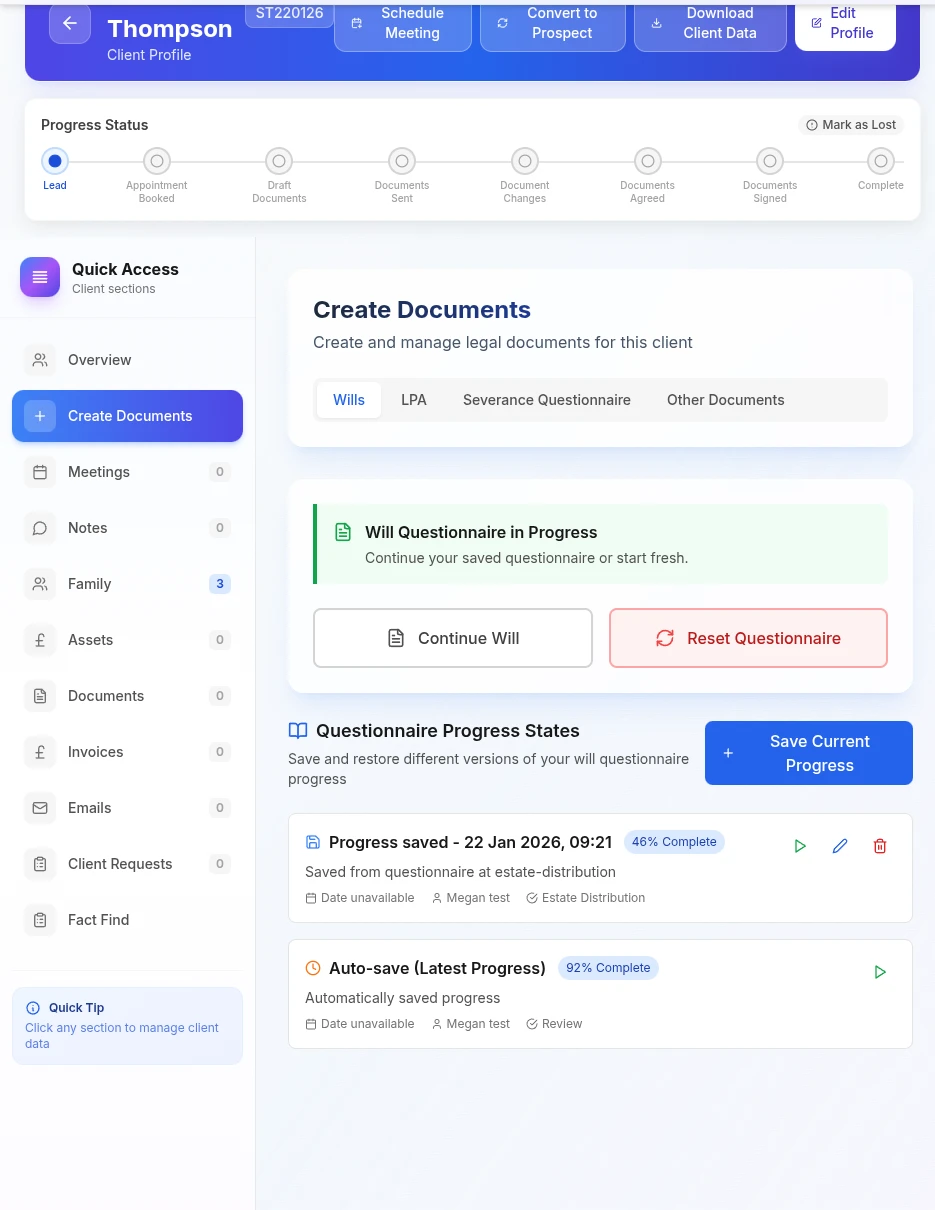
Everything about the client on one record, with the case stage across the top.
Willo includes a client CRM built specifically for estate planning work — not a general-purpose contacts database with wills bolted on. Family trees, asset tracking, document history, notes, and a pipeline from first enquiry through to signed and stored. Included in the £150 monthly price.
Why estate planning breaks ordinary CRMs#
A CRM designed for sales models a company, a contact and a deal. Estate planning has none of those. It has a testator, a spouse who is also the executor, three children of whom one is a beneficiary and two are replacements, a house held as joint tenants, a sister appointed guardian, and a charity receiving a pecuniary legacy.
Try to hold that in a contacts list and the relationships — which are the whole substance of the work — end up in a notes field. Nothing can validate a notes field. Nothing can tell you that the executor you appointed in the will is the same person you removed from the family tree six months ago.
What is on the record#
The family tree. Spouses, children, stepchildren, grandchildren, and the relationships between them, held as structure rather than prose. Drafting draws from it, so the same person is never spelled two different ways across two documents.
The assets. Property with tenure, accounts, policies, business interests, chattels of note. What is in the estate, what is held jointly, and what has been dealt with by a specific gift.
Every document. Every will, LPA, trust and letter produced for that client, with versions, so you can see what was signed in 2021 when they ring you in 2029.
Every email. Sent from your own domain, filed against the person automatically, so the history is in one place rather than split between the system and your inbox.
Notes and meetings. Including video meetings held inside Willo.
The pipeline#
Every case sits at a stage — enquiry, fact find, instructions taken, drafted, out for approval, awaiting execution, complete. On one screen you can see which cases are stuck and where.
This sounds like project management furniture until you have had a will sit unexecuted for four months because nobody could see it. The cases that cost you money are not the difficult ones. They are the ones that went quiet.
Follow-ups, which are the real product#
The follow-up hub is the part practitioners tell us changed their month. Reminders against the case rather than against your memory, chasing the signature, the outstanding fee, the review appointment you promised in three years' time.
A client who made a will with you in 2026 should be a client who reviews it with you in 2031. Almost nobody manages that, and the reason is never that they did not intend to.
Related#
Client communication · Invoicing and payments · Will drafting · Pricing
Questions about the client record.
Why not just use a general CRM?
Because a general CRM has no concept of a testator, an executor, a residuary beneficiary or a severance. You end up modelling a family in a contacts list and a case in a deal pipeline, and the relationships — which are the entire point in estate planning — live in free-text notes where nothing can check them. Willo's record holds the family as a family.
Is the CRM an extra cost?
No. It is included in £150 a month along with everything else.
Can I import my existing clients?
Yes. Export from your current system and we will map and import it rather than handing you a template spreadsheet and wishing you luck. See switching.
Is client data held in the UK?
See security and data for where data is held, how it is backed up and how you get it out.
See it draft one of your cases.
Book a walkthrough with someone who drafts in Willo every day. They will open your kind of case, not a demo script, and you can stop them and ask anything.
Or call 0333 049 5033 — Mon–Fri, 9am–6pm.